Since 2017, the Chimie sous Rayonnement-Radiochimie sub-division (SCF/SFP) has been organizing a conference dedicated to radiochemistry, radiation chemistry, and nuclear chemistry.
After the first three successful editions in Strasbourg (2018), in Nice(2022 ), and in Nîmes (2024), the 4thRencontres Rayonnement Radiochimie (R3C) will be held in 2026 at the University Paris-Saclay (Orsay). Registrations are now open. You can register via the « Navigation/ My registration » tab and submit your abstracts (maximum 1 page, abstract template (R3C2026_ABSTRACT_NAME.docx) by email for an oral presentation or a poster in one of the topics listed below.
- December 2025 : Opening of registration and abstract submission - March 31, 2026 : end of the call for abstracts - March 31 : end of early bid registration - April 2026 : Notification to the authors - April 30, 2026 : registration deadline - June 8-11, 2026 : R3C-2026 conference
Scientific Topics & Invited Speakers
- Radiation Chemistry - Chemistry of Radioelements - Radiobiology& Health - Experimental Facilities, Large Instruments - Industrial Applications & Fuel Cycle - Environment & Field studies
Invited speakers: Jean AUPIAIS (CEA-DIF) Xavier COQUERET (Univ. Reims) Lucie HUART (AERIAL-CRT) Kristina KVASHINA (ESRF) Anne LAFOSSE (Université Paris-Saclay) Aashini RAJPAL (Institut Gustave Roussy) Florent REAL (PhLAM, Univ. Lille)
Preliminary schedule
A detailed schedule and session program will be available soon.
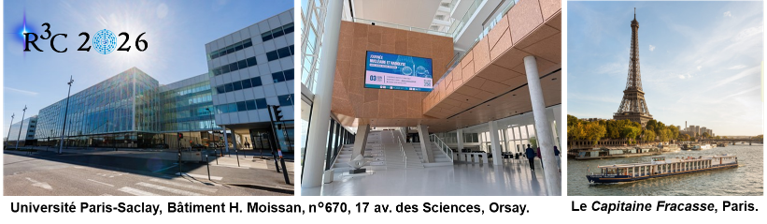
The R3C-2026 conference will take place in the Henri Moissan Building, Faculty of Pharmacy, Université Paris-Saclay. All sessions will be held in the Hervé Daniel Auditorium, with a capacity of up to 180 participants.
Paris-Saclay University is easily accessible by public transport (RER B, Bus 4606, 07, 09, 59). Accommodation is available directly on the plateau, in Massy-Palaiseau (TGV station) or in central Paris.
The gala dinner will take place on the ship ‘Capitaine Fracasse’. It will take us on a dinner cruise on the Seine on Wednesday evening.
Social Events
Participants who wish to do so may take part in group tours on Thursday afternoon. A pre-registration email will be sent to participants with the provisional programmes. Free registration will be finalised on site, subject to availability.
Planned visits include (to confirm) : - CEA Saclay, irradiators at the Applied Radiation Laboratory (LABRA) and the linear electron accelerator ALIENOR (NIMBE) - SOLEIL Synchrotron, PLEIADES beamline - Sciences ACO, the first Collision Ring, now the Orsay Museum of Light and Matter - MOSAIC irradiation and ion implantation platform inIJCLab
Inscription tardive (du 01 au 30 Avril 2026) - Tarif inscription tardive: 500 € *Pour des raisons logistiques, aucune inscription ne pourra être effectuée après le 30/04/2026 Modalités de paiement : L'inscription aux R3C se fait sur ce site SciencesConf' Rubrique "Navigation / Mon Inscription" Elle ne sera validée qu'à réception du paiement par une des méthodes suivantes :
1) Par virement bancaire (à privilégier) - Le virement se fait directement à la SCF, en précisant en intitulé "CRRC R3C2026 Nom Organisme" et en utilisant l'IBAN ci-joint IBAN_SCF_Inscription_R3C_2027.pdf
2) Par bon de commande - Si vous le souahitez, un bon de commande de la SCF peut être édité après inscription. - La commande est à régler en précisant dessus le nom de la personne à inscrire. Il est possible de regrouper plusieurs inscriptions sur un même bon. Les commandes nominatives doivent mentionner nom, prénom, et institut de l'inscrit, Exemple d'intitulé : "CRRC R3C2026 Nom Prénom Organisme" Les commandes groupées doivent mentionner la liste des inscrits. L'intitulé du virement doit préciser l'identifiant du groupe: "CRRC R3C2026 Groupe Organisme"
- Sans ces mentions, l'enregistrement ne sera pas possible - Merci de nous confirmer par mail votre virement / règlement en précisant : la date, montant et intitulé du règlement: CRRC R3C2026 Nom/Groupe Organisme, ainsi que le mail des personnes inscrites.
Acknowledgments & Sponsors
The R3C-2026 conference is co-organized by: Université Paris-Saclay, CNRS and CEA,